
Where they lived
The 19th century records show that Cricklade Street was a densely populated area and the area where most of the Fletchers of Cirencester of that era lived.
There are mentions of Dyer Street to the east of the Market Place and Gloucester Street to the north but it would seem that as the population of Cirencester grew and places started to become overcrowded the general movement of population was to the south.
We know that some dwellings in Cricklade Street were condemned as unfit for human habitation during the mid to late 19th century and so there was inevitably some movement away from the highly populated Cricklade Street.
Some Fletchers had already spilled around the corner from Cricklade Street into Lewis Lane but the big movement was in the late 19th century as the suburb of Watermoor was developed.
Watermoor Road has the earliest mentions and then as Midland Road and School Lane were built so many Fletchers moved there.
The records also show Fletchers living in Cecily Hill, Dyer Street and Spitalgate Lane amongst others.
The 20th century saw the development of civic housing and as a result Fletcher families moved for better housing to Kingsmead, Querns Road, Chesterton and later The Beeches.
I am grateful to Derek King and Robert Heaven’s ‘Old Ciren’ Facebook page for most of these photographs

Cricklade Street #1

Cricklade Street #2

Cricklade Street #3

School Lane (Now demolished)

Midland Road (Now demolished)
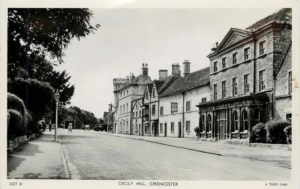
Cecily Hill

Corner of Cricklade Street and Lewis Lane

Watermoor Road
Local Pubs
I was going to add a little about local Pubs the Fletcher families used over the years but I don’t have too much in the way of evidence of which pubs they used. We do know that The Wheatsheaf (still in existence) in Cricklade Street was close to the homes of a number of the Fletchers living in Cricklade Street during the 19th Century so we can probably assume it was frequented regularly.
The photograph of Cricklade Street shows The Bishops Blaize (no longer in existence) and we know from family chatter that a popular pub with some Fletchers was The Dolphin (now closed) in Cecily Hill which may be related to being close to the Barracks and used by soldiers and ex- soldiers. We know too that The Bell Inn was situated at the junction of Cricklade Street and Castle Street. Additionally, Cirencester’s Brewery (owned by the Cripps Family) was situated on Cricklade Street and at its peak covered a very large area of the existing Brewery Car Park.

[Entrance to Cirencester Brewery in Cricklade Street]
Employment Mobility
The records give a pretty good indication of how employment mobility changed over the 240 years of this project.
In the 18th century there is little evidence of any significant mobility other than around the local area but in the 19th century things began to change especially after the arrival of the railways in mid-century.
One of the interesting observations when reading through the records was that it seemed as though it was young women in the late 19th century and early 20th century who moved away for work taking jobs “in service” in London, Wales and the East Midlands for example.
Where there was employment mobility amongst young men in the early and mid-19th century it occurred mostly where they had a trade such as Frederick Fletcher in the 1850’s who trained as a Blacksmith and then moved around eventually settling in Weston-Super-Mare.
One of the most interesting examples of employment mobility in the project was William Hulbert Fletcher who was a Mason’s Labourer and who moved with his family from Cirencester to Skelton in the Borough of Guisborough, North Yorkshire, a distance of around 250 miles, in the 1870’s which almost certainly would’ve been made by horse and cart. It must have been a long-term employment arrangement as his daughter Georgina Hulbert Fletcher was born in Skelton.
The other factor presumably in the changing nature of employment in the 19th century with agricultural jobs diminishing and urban businesses growing.
By the end of the 19th century we also see the emigration of some Fletchers to Canada and Australia as the Colonies seek to increase their workforces.
By the time we get to the early 20th century education has improved and rail travel is in full flow and there are the beginnings of public transport by bus which also supports employment mobility although our group of Fletchers do not generally move far.
In my own family moving to London for work seemed a popular move, with almost all my Dad’s siblings taking up employment in London in the 1920’s and 1930’s. (Mary and Frederick never returned to Cirencester and James only for a short period before moving on again. Arthur returned for 18 years but then moved to nearby Swindon. Elsie returned to Cirencester).
The Records and Literacy
The records show a marked difference from the first half of the 19th century to the latter part of the 1800’s.
Whilst signatures are not the be all of indicators (as some people learned to write their name but nothing else) most of the records such as Marriage Banns and Birth Certificates show that in until after 1860 most signatures were a ‘mark’ witnessed by an official (priest or registrar).
This started to change significantly when The Elementary Education Act of 1870 was introduced to create compulsory education for children aged between 5 and 13. (This education was not initially free, but it was relatively inexpensive)
This Act and others which followed changed the literacy landscape across the country and by the end of the century most children were literate and that had its knock-on effect amongst adults.
The records reflect that progress with virtually no indication of illiteracy in the late 1800’s.
Cirencester Churches
Almost all of the Parish Records in this project are derived from the Anglican Cirencester Parish Church of St John the Baptist a church often known as ‘the Cathedral of the Cotswolds’ and which has been in existence for almost 900 years. It dominates the town and for the Fletcher’s of Cirencester it is obvious from the various records obtained from the Parish that it was central to the formalisation of family life particularly in the 19th century. This comes to life in the more poignant moments in the records where it is quite apparent that parents have rushed to have their young ones baptised if they are sick or near to death.
The other Anglican Churches in Cirencester are:
- Watermoor Church of Holy Trinity was built in the 19th century as Cirencester expanded southward toward Watermoor and whilst there are a handful of records from the church all the parish records actually centre on St John the Baptist.
- St Lawrence Church (Anglican) in Chesterton was built after the WWII and opened in 1951.
The many other Churches in Cirencester may have had their records in a specific ‘Non- Conformist’ Baptism, Marriage and Burial Register but there does not appear to be one for Cirencester in the on line records.
The largest of these other churches is St Peter’s Church in Ashcroft Road which is the town’s Catholic Church and built in 1896. The town has a Methodist Church; a Baptist Church; a Friends Meeting House and a Salvation Army church amongst others.
Population of Cirencester 1700 –1951
The following figures have been noted from various online sources and articles, but I think can be regarded as reasonably accurate. It is worth noting the doubling of Cirencester’s population in the 19th century which is only half the level of increase in the UK’s population at this time.
In 1700 the population was around 4,000 people
In 1800 the population was just over 4,000 people
In 1841 the population was 6014
In 1861 the population was 6336
In 1900 the population was around 8,000 people
In 1951 the population was around 14,000 people
(Note: some redrawing of the Town’s boundaries influenced some of the population figures)
[This section needs more research]
Public Health & Epidemics Affecting The Fletchers of Cirencester
Cirencester History websites refer to Smallpox outbreaks in the 18th century (1741 and 1758) which almost certainly would have affected the poorer people of the town. The online records Parish records don’t tell us what people died of.
I was taken aback when researching details of Fletcher deaths in the 19th Century when I found two consecutive pages from the Parish burial records of 1870.
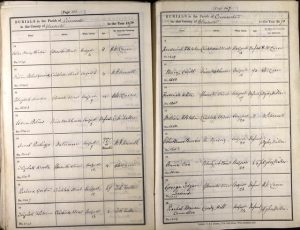
These two pages alone record 16 burials in total over a three-week period in August 1870. 12 of these burials were infants and children. An article published by Cirencester Archaeological and History Society (CAHS) in their 2020 Newsletter indicate there was an outbreak of Scarlet Fever and Typhoid in the town in 1870 and over 70 deaths were recorded attributed to the outbreak. As someone who contracted Scarlet Fever when I was 6 years old this fact impacted me more than I expected and makes me truly grateful for medical progress and the NHS !
Apart from this article I haven’t found any research which provides more details about the health and living conditions of working people in Cirencester. Perhaps there are some and if I find anything I will refer to them here.
How much did they Earn ?
[Average Pay Levels ]
ADD SECTION
The Fletchers and Leisure Time
Did they have any?… is a question I asked myself.
The online records don’t provide a facility to tell us about The Fletchers of Cirencester’s leisure time activities, but we can pick up a few things from other recorded information.
For example, in the newspaper report of William Hulbert Fletcher (B:1848) and his wife Mary’s double funeral in 1932 (see picture below) there is a comment that William had a “keen interest” in Cirencester Town FC and this is likely to be the case for some more Fletcher men in the late 19th century and beyond after the club was formed in 1889.
We know too of some pastimes The Cirencester Fletcher’s were involved in and the best example of this is James Fletcher (B:1880) with his involvement in Cirencester Cage Bird Society. James was a prolific prize winner as the picture in his bio shows and was an active member of the Society’s organising Committee.
As a kid growing up in Cirencester I used to love it when May came around and we could go to the Open Air Swimming Pool (at that time there was no indoor pol in the Town).The Open Air Pool was opened in 1870 .. so did Fletcher folk use the pool from when it was opened? Or was the general use of the pool something that developed in the 20th Century?
Cirencester Cricket Club play at a beautiful ground in Earl Bathurst’s Cirencester Park and as youngsters if our Sunday afternoon family walk took us that way it was not unusual to wander off the normal path through the Park to call in on the Cricket. The Cricket Club was founded in 1862 … so was this something that 19th Century Fletchers did too?
My Dad wasn’t a great fan of hunting (in fact listening to some of his tales some of his time as a teenager was spent mocking the local hunt) but he did love to take us to the local Point to Point at Siddington in March if the weather was reasonable. The first Point to Point was held in 1909 so did many Fletcher families go to the races?
I used to spend a lot of time with my Dad on his Allotment along Somerford Road (which at that time was next to the Football ground … so two birds with one stone!) and in the process learned a little bit about gardening. This was not long after WWII so allotments were more important to families for unrationed fresh vegetables but how many Fletchers had allotments especially where they had little in the way of gardens where they lived?
Cirencester always had thriving Horticultural societies in the 20th century did they exist in the 18th and 19th Centuries?
When I was growing up the Fletchers I knew were often involved in pub based games such as Skittles and Darts with highly competitive leagues in and around the town. Card games of various sorts also prevailed (with Cribbage being a favourite of my dad’s) and Whist Drives were both social gatherings and fundraisers. Did the Fletchers of the 18th and 19th century also have their favourite pub games?
Cirencester Park has a significant reputation for high quality Polo, a sport which has its origins in Ancient Persia but which was introduced in Great Britain in the mid-19th Century. The Cirencester Park Polo Club was established in 1894 and I recall as children we would walk as a family to the polo ground normally entering through an entrance to the park along the Stroud Road. We were not avid supporters of the polo but it was a learning experience especially to a little lad like me hearing some of the language used by the players including characters such as Jimmy Edwards!! Did our Fletcher ancestors also go along as spectators? Were any involved with the Club through Earl Bathurst’s estate?
It would be nice to find some record (written or photographic) of how working people were involved in the various societies and social events in Cirencester over the years.

Observations on the History and Politics of Cirencester
I am not an historian but I enjoy history particularly Political, Social and Economic History.
My interest in History must have been influenced at least in part by where I lived for the first 18 years of my life. Other factors will have played their part too but growing up in Cirencester means history was always prevalent.
The history that dominated was Roman history because there were always so many discoveries and artefacts around us not least the Roman roads that led to and from the town.
I grew up on a council estate in Chesterton, and Chesterton was itself originally a Roman encampment. I was lucky that my playground was quite often what we used to call the Bullring but cared for now by English Heritage as the Roman Amphitheatre.
Our primary school trips included places like the Roman Villa at Chedworth and my regular personal visits to the Corinium Museum always left me in awe of what went before.
The story that dominated for me was the Roman settlement of Corinium Dubornum had a population of over 10,000 people and an area of 240 acres second only to Londinium in size (a fact I was always proud to tell my London cousins!).
It was the largest Cirencester was to be for most of the following two thousand years because the departure of the Romans towards the end of the 4th century saw the town decline rapidly and return to a small settlement. As a teenager I always felt slightly disappointed by that outcome principally because there didn’t seem to be a follow up narrative but there is more to Cirencester than the Roman period and gradually I have become aware of more of the developments affecting Cirencester over the years. (Saxon pillaging and The Civil War for example)
The one era that doesn’t get much coverage in Cirencester is the period of the Industrial Revolution from 1750 to 1900. Not surprising really as the town has remained agriculturally based throughout other social and economic changes and in fact delivered to the world the very first Agricultural College (now a University).
Nevertheless, there was some flirting with the great change that affected many other parts of the UK and the records show that this era did support working people with evidence of Fletchers working at the Canal Wharf; on the Railways and in a Iron Foundry need to support industrialisation.
The railway arrived in 1841 and for many years the town had two stations; one operated initially by the Cheltenham and Great Western Union Railway (later the GWR) and the other at Watermoor operated initially by Midland and South Western Junction Railway. The town was also had a canal connection with the Cirencester Branch of the Thames and Severn Canal which ran from Stroud to Lechlade joining Britain’s two great rivers. Sadly all connections with the Railway and Canal eras are no longer in existence (except the Town Station building designed by Brunel) and it is interesting to consider what impact the retention of these structures would have had on the town today.
There is plenty to find out about Cirencester including the imposing Parish Church of St John the Baptist and the five hundred years of existence of the Grammar School.
There are also a number of publications by local authors which help to understand the town included in these are a couple by Peter Grace who I knew at school.
To know more about the town in the time of the Second World War it is worth reading Little Eden, a story of a young German Jewish refugee who came to study at school in Cirencester.
Finally I would strongly recommend any visitor to Cirencester making a beeline for the Corinium Museum (a place I loved to mooch in the 1950’s when I was just a little lad) and if you want to find out what local historians have been interested in it is worth looking up Cirencester Archaeological and History Society (CAHS) on line.
In terms of political history there didn’t seem too much to say as it seemed to me like Cirencester has been a Conservative town since Adam was a lad.
This is basically true but whilst the 18th Century and early 19th Century couldn’t have involved The Fletchers of Cirencester in politics very much and probably not at all as the national political system was basically two parties (Whigs and Tories) who selected the MP’s (there were two) for Cirencester with a very small electorate. The online information indicate that land owning families dominated the selected MP’s for Cirencester right up to 1918* (when the Cirencester constituency was replaced with the new Cirencester & Tewkesbury) … the Bathurst and the Master families although they didn’t always get their way – looking through the records on one occasion the very limited electorate of Cirencester elected a Whig in 1754 rather than a second Bathurst Member of Parliament.
*[The Cirencester constituency was replaced in 1918 with the new Cirencester & Tewkesbury constituency]
The UK establishment had seen the effects of the French Revolution and as a result the 19th century started to see electoral change. The Reform Act of 1832 did away with “Rotten Boroughs” (e.g., Old Sarum in Wiltshire had an MP and only seven voters) and extended voting rights to those who owned land and businesses.
Further Reform Acts in 1867 and 1884 further extended voting rights and it was the 1884 Act that provided the Fletchers of Cirencester with the right to vote both at County and National elections – providing they were over 21, Male, and a Householder (Owner or Tenant) – it is estimated that across the UK this move gave the vote to two out of three men. It is at this point we start to see Electoral Roll records starting to appear with various Fletchers listed.
The choice of who they elected was limited in the 19th Century to either a Liberal or a Conservative with the Labour Party not being formed until 1900.
The next great step toward Universal Franchise had to wait until 1918 when the Representation of the People Act was enacted. This gave the vote to all men over 21 with no property requirement and to women providing they were over 30 years of age and met a property qualification, or whose Husband did! So in this change about two thirds of women gained the right to vote and again the Electoral Rolls in the records reflect this with female names appearing for the first time!
Universal Franchise for those over the age of 21 finally arrived in the Representation of the People Act 1928 which is when we get so much more information about The Fletchers of Cirencester. The electoral roll is quite fascinating as more of the male Fletcher’s of Cirencester who were householders started to appear on the voting lists in the late 19th century initially in alphabetical order and later as voting for women was achieved it changes to being listed by road/street.
As all voting is secret, we cannot tell the politics of the Fletcher’s of Cirencester listed in this project and I suspect given that survival was the order of the day who was in power was not high on their agenda although as more of them became enfranchised in the 19th century it’s easy to imagine their satisfaction at having some say in the politics of the County and Country.
We do know from The Tolpuddle Martyrs that rocking the political and economic boat didn’t go down well anywhere in the 19th century particularly in rural areas. There is an interesting story written by Mary Bartlett in Ottaker’s Local History book “Cirencester” which details how her Grandfather William Tanner, a Farmworker, dared to ask for more money for himself and his co-workers and was blacklisted as a troublemaker in the area for many years. Farming communities were close, and word got around, and a bad word seemed to carry further.
The Fletchers of Cirencester males who did have the right to vote in the 19th century had voting rights for both national and county elections and in 1894 their interest was probably heightened when the Cirencester Urban District Council was created. The CUDC existed until 1974 when the new Cotswold District Council was created so the CUDC was the local council as I was growing up in the town. I was always intrigued and impressed with the council’s logo of a Phoenix rising from the ashes and during this project I have come across one explanation of why the Phoenix was chosen. According to one article it represents the rebuilding of the town after the sacking of the post Roman settlement by the Saxons. I don’t know how true that is but what is clear is that the town had grown significantly in the 19th century almost reaching the size of Roman Corinium and maybe this was also in the minds of councillors in the 1890’s.
Cirencester’s Workhouse
No social history of Cirencester’s working people would be complete without some reference to the infamous Workhouses of the 18th and 19th Century.
The origins of institutions like a Workhouse and the state taking responsibility for the poor can be traced back to the 14th Century when England faced labour shortages as a result of the outbreak the Black Death pandemic , but the first Poor Relief Act was not introduced until 1576 and this was then supplemented by the Act for the Relief of the Poor in 1601 when parishes were made legally responsible for the care of those in their parishes who were unable to work either through age or infirmity.
The premise for all the Poor Laws right through to the 19th century was the view (which sadly still prevails in some places) that the poor were poor because they were idle or workshy and not for any social/economic reasons. The emphasis therefore in all systems and processes to deal with poverty was to provide work and it was this concept that led to evolution of workhouses in the 17th century as places where work could be found.
In 1723 a new piece of legislation (The Workhouse Test Act) was introduced aimed at preventing illegitimate claims on local parish poor funds which required anyone seeking poor relief to enter a workhouse and undertake a set amount of work usually for no pay in a system called ‘indoor relief’.
It was Thomas Gilbert’s Act of 1782 which made the major change to the establishment and operation of Workhouses as it allowed parishes to join together to form ‘Unions’ (today we might call them shared services), which enabled parishes to achieve some economies of scale.
Gilbert Union Workhouses as they were known enabled parishes to come together to build larger buildings which could accommodate the elderly and infirm as well as finding work for the more able bodied folk.
The concept was helpful but not all were well managed and many did not have purpose built premises but used rented accommodation to accommodate people. In some cases the Workhouse was in effect a poorly run factory which raised concerns amongst Poor Law Commissioners.
According to a report in 1724 the 18th century Workhouse in Cirencester was run as a factory and was sub contracted by the parish to an individual who was paid £50 a year plus payment of 10 shillings a year per person for two deputies. They were housed in a refurbished and extended property called Chesterton-House where they undertook Woollen and Yarn Manufacture. A report in 1729 indicates the arrangement was a success in reducing the “Taxes for the Relief of the Poor”. The report also shows the number (“the family”) included in the Workhouse had increased over the five year period from 30 to over 100.
A parliamentary report in 1777 recorded a parish workhouse in Cirencester for up to 120 inmates.
A major development for Workhouses was in the early 19th century when the country was facing a significant economic downturn and increasing unemployment following the Napoleonic Wars. The amount spent on poor relief in 1832 had grown to a massive £7 million a year compared to £2 million fifty years before.
Following a Royal Commission in 1832 a centralised Poor Law Commission was established for England and Wales under the Poor Law Amendment Act of 1834 (which was also known as the ‘New Poor Law’)
Under the new centralised Commission individual parishes were grouped into Poor Law Unions and each grouping was required to have a Workhouse.
This is where things started to change in Cirencester.
Before the 1830’s Cirencester had its own Workhouse but on the 21st January 1836 following the establishment of the newly created Poor Law Unions, the Cirencester Poor Law Union was formed with a 43 man Board of Guardians covering 39 constituent parishes which stretched into North Wiltshire.
Following the newly established Board money was raised to fund a brand new purpose built Workhouse in Cirencester to support all the parishes. This was authorised by the Poor Law Commission and built on the site of the previous Cirencester Workhouse which had been demolished. The new development had accommodation for 300 ‘inmates’.
Included in the plans was the Cirencester ‘Lock up’ which had previously been in Gloucester Street.
We don’t have any indication of how successful the new Workhouse was in terms of the treatment of those included in the institution either in the 18th or 19th centuries.
Anyone who has read Dickens will know the reputation of Workhouses in the 19th century was not great but as with all things it probably depended on the attitude of those running the establishment and we know from the 1881 census that there was, at least for a few years, a family running the Cirencester Workhouse; a Master (a Mr Freeman); his wife who was the Matron. Also living there were his three daughters and a son. They were still in charge in the 1891 census and one daughter had become a schoolmistress in the Workhouse.
They were not likely to be great places to be because they had to be run frugally so as not to place a greater burden on the local taxpayers and therefore it was a probably a question of the degree of oppression that prevailed.
Although conditions would have been harsh there is a good chance that the children who were “inmates” would at least had some education with the prospect of some level of improved literacy.
Without a detailed analysis a perusal of the census entries from 1841 to 1911 seems to indicate the demographic spread of residents were getting older as the decades slipped by, indicating that the probable focus moved gradually to accommodating the elderly poor. Not really surprising when one realises that there was no old age pension and many former agricultural labourers and their widows would have been previously living in tied cottages which presumably were not available when there was no longer a job to be done.
The census reveals too that the original concept of catering for the various local parishes seems to change over the years as residents originate from places like Devizes, Witney and Pershore amongst others.
The 1871 census lists “Vagrants” in the Workhouse suggesting the Workhouse became a convenient place to accommodate the homeless of the day.
The Cirencester site was used throughout the 19th Century from 1836 onwards and into the 20th century firstly as a Workhouse and then gradually used more and more to accommodate the elderly and less able.
In 1930 the site was taken over by Gloucestershire County Council as a 200 bed Public Assistance Institution and with the formation of the NHS in 1948 it became Watermoor Hospital.
The local council took over the buildings about 1980 as their offices and the building still stands much as it did in 1836 (including the lock-up!)
Residents of the Union Workhouse were included in each ten year census as a distinct section and in terms of the Fletchers of Cirencester there is hardly any mention of a Cirencester Fletcher over these census years.
The only Fletchers of Cirencester that could be found on the various 19th century census entries were two girls in the 1861 census. The record shows there was an R Fletcher (B: 1850) aged 11 and M A Fletcher (B: 1852) aged 9. (No trace of who they were etc. has yet been found in the Births Marriage and Death records online)
There were a handful of other Fletchers from around the parishes entered on the census but probably the saddest entry was in 1881 where there is a record of Eunice Fletcher aged 50 who was from Poulton and the daughter of a Farm Labourer, and is recorded as “Imbecile from Birth”….a description which sadly indicates attitudes at this time.
In general, it looks like The Fletchers of Cirencester avoided involvement with the local Workhouse in the 19th century this changed a little in the early 20th century with the baptism record of Francis Fletcher born in 1902 where it identifies that the residence of his mother Georgina was the Workhouse. The baptismal record pointedly notes that Georgina was a “single woman” and two other baptisms that day were for children where the mother was referred to as “single woman” and both gave their residence as the “Workhouse”. It is assumed that Georgina’s two other children aged 5 and 2 were also accommodated in Cirencester Workhouse.